The Mohs scale is an essential tool in geology, mineralogy and even jewellery. It is a comparative system that measures the relative hardness of minerals, i.e. its ability to resist being scratched by other materials. Although developed in the 19th century, it is still widely used today for its simplicity and practical utility.
What is hardness in minerals?
In the field of mineralogy, the hardness does not refer to toughness or fracture toughness, but exclusively to the resistance of a mineral to scratching. This physical property depends mainly on the internal crystal structure and the type of atomic bonding that binds its components together.
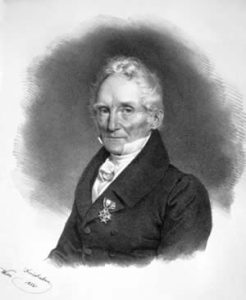
A hard mineral will easily scratch a softer one, but the reverse will not be true. This simple observation is the principle on which the scale he developed is based. Friedrich Mohs, a German mineralogist, in 1812.
How does the Mohs scale work?
The scale consists of 10 reference minerals, The list is ordered from the softest to the hardest. Each of these can scratch all the previous ones in the list, but will be scratched by the ones after them. The scale is not linear; this means that the difference in hardness between two consecutive minerals is not necessarily the same. For example, the diamond (10) is significantly harder than the corundum (9), even if they are adjacent to each other on the scale.
The 10 standard minerals on the scale are:
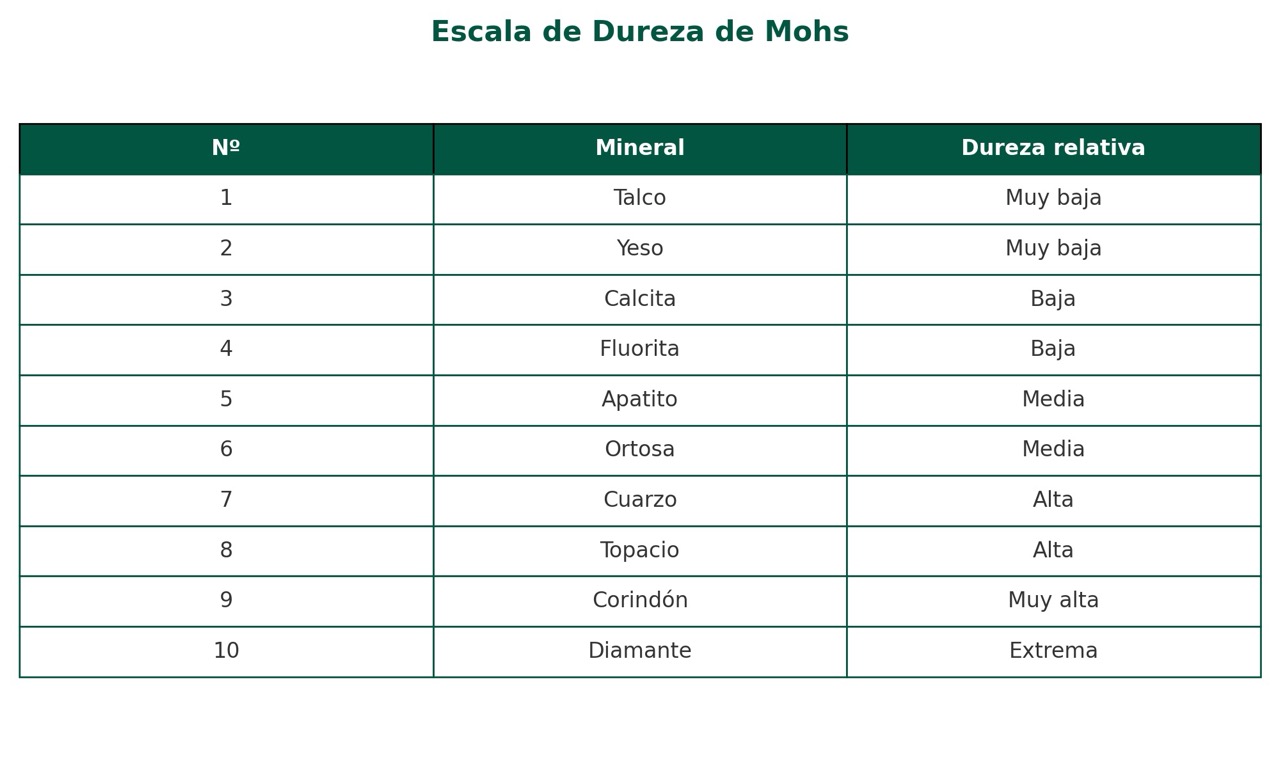
Talc - Extremely soft, melts to the touch.
Plaster - Although soft, it can be easily scratched with the fingernail.
Calcite - It is scratched with a copper coin.
Fluorite - It has a vitreous lustre; it scratches with a steel knife.
Apatite - A common component of tooth enamel.
Orthosa - A common type of feldspar.
Quartz - Very abundant in the earth's crust and in gemstones such as amethyst.
Topaz - Precious gemstone, harder than quartz.
Corundum - It includes varieties such as sapphire and ruby.
Diamond - The hardest known natural material; it can only be scratched by another diamond.
Practical examples and everyday objects
In addition to minerals, there are common objects that can also be used as a reference to estimate the hardness of an unknown mineral:
Human fingernail: ~2.2
Copper coin: ~3
Steel knife: ~5.5
Window glass: ~5.5-6
Silicon carbide sandpaper: ~9.5
For example, if a mineral is scratched by a fingernail but not by gypsum, its hardness is below 2. If it can scratch a crystal but not a topaz, its hardness would be between 6 and 8.
Applications of the Mohs Scale
1. Geology and Mineralogy
In mineral identification both in the laboratory and in the field, the scale is an essential tool. Geologists often carry a hardness kit, with samples of the 10 minerals, as well as other objects (such as glass fragments or metal files) for quick comparisons.
Hardness helps to differentiate minerals with similar appearance. For example, the gold and the pyrite They can be visually confused, but their hardness distinguishes them: gold has a hardness of 2.5-3 and pyrite has a hardness of about 6-6.5.
2. Jewellery and Gemmology
In the world of jewellery, the Mohs scale allows you to assessing the durability of a gemstone, This is key when deciding on its use in different parts. For example:
The diamond, The 10 hardness is ideal for engagement rings due to its resistance to daily scratching.
The topaz (8) or the sapphire (9) are very durable, perfect for frequently used jewellery.
The turquoise (5-6) or the lapis lazuli (5-6) are more delicate and are reserved for pendants or earrings, where wear is less.
It is also used to detect counterfeitsa gemstone that is supposed to be a sapphire but is easily scratched is probably not.
3. Industry and Technology
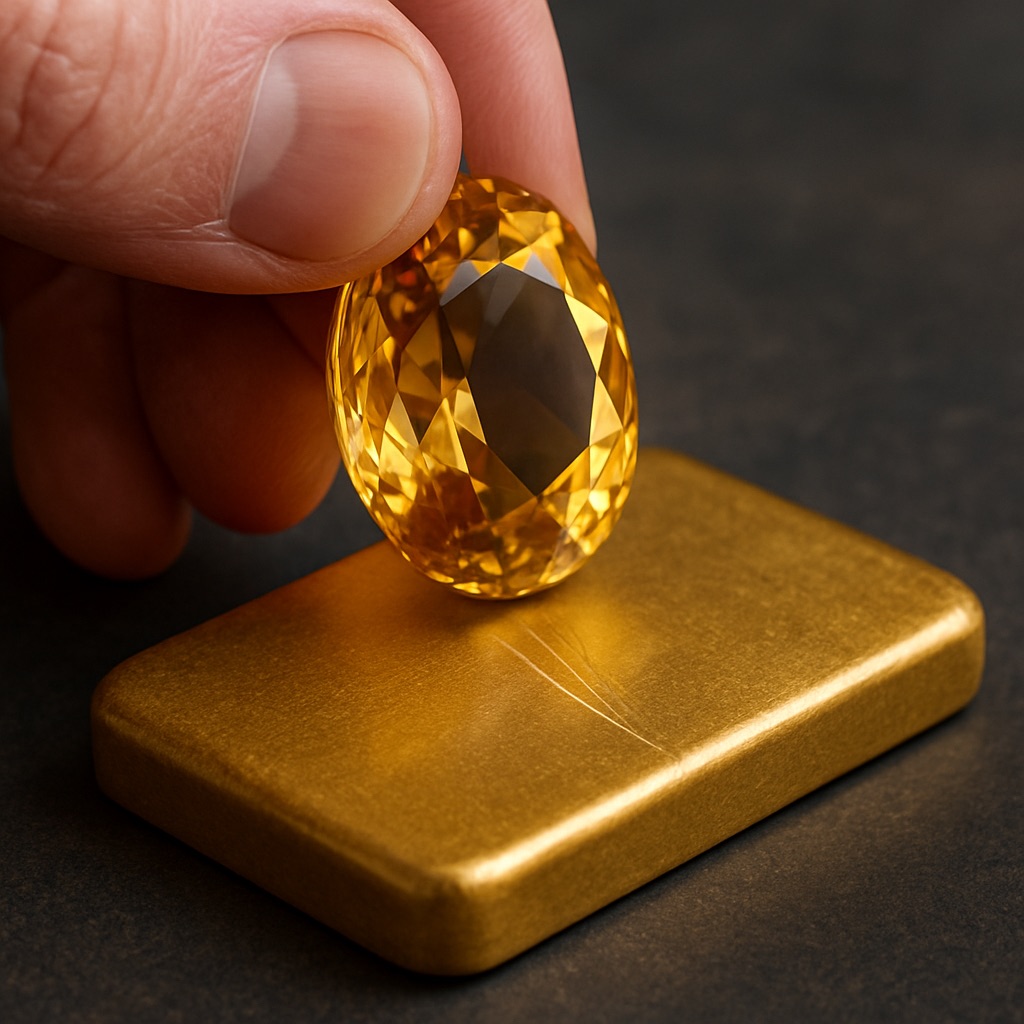
The Mohs scale is useful for selecting suitable materials for tools, coatings or components subject to wear. For example, the industrial diamond drill bits are used for drilling rock or cutting extremely hard materials.
In the world of technical coatings (mobile phone screens, ceramic coatings, etc.), materials with high Mohs hardness are used to increase scratch resistance.
Limitations of the Mohs Scale
Although the Mohs scale is extremely useful for its practicality, is not an absolute measure of hardness. Other scales such as the Vickers, Brinell o Knoop provide quantitative values based on tests with specialised equipment.
For example, although diamond has a hardness of 10 on the Mohs scale, on the Vickers scale its hardness can be over 10 times harder than 10 on the Mohs scale. 10,000 kg/mm² 10,000 kg/mm² 10,000 kg/mm² 10,000 kg/mm², whereas that of corundum is approximately 2,000 kg/mm² 2,000 kg/mm² 2,000 kg/mm² 2,000 kg/mm, This shows a big difference between the two, even though they are next to each other on the Mohs scale.
Conclusion
The Mohs scale remains, more than two centuries after its invention, a fundamental tool for understanding and classifying the hardness of minerals. Its use extends beyond geology to jewellery, industry and education.
Knowing the hardness of a stone not only allows you to appreciate it better, but also to assess its strength and suitability for each type of jewellery or technical application. So, whether to identify a mineral in the field, to select a durable gemstone or to assess the quality of a product, the Mohs scale remains a universal standard.